Clair Maleney, Embedded Researcher at Sheffield Hallam University, talks about making personas.
When I first started my work as an Embedded Researcher with darts, they asked me if I’d be able to make a persona of a person who attends Creative Directions.
I’ll admit – I felt a little trepidation. It’s not something I’d ever done before and I was worried that any persona I created might be a reproduction of my own unconscious biases or stereotypes.
Literature review
So to the books I went, thinking ‘how have others tackled this issue?’
What I found was that the methodology for personas comes from two different schools, one of those was from a social science perspective, and the other was from the data and computer science field of user research, or UX as its otherwise know.
UX approaches often rely on having a lot of user data and distilling this perplexing quantity of data into personas. These personas can help when designing the customer or user experience to best serve that type of person.
Within social sciences the articles I found were often drawing from interviews data, and using a bricolage or portraiture approach to mask and amalgamate the identities of vulnerable or high-profile research participants.
Data collection
Given dart’s thorough record keeping of participant data across ten years, I was able to design an approach that would draw on both these methods: I created segments of user types based on attendance profiles, and then interviewed a number of participants who fit within each of these attendance profiles.
I conducted these interviews using a technique proposed by researchers for generating case studies of people’s experience of counselling and psychotherapy. In the interviews I asked the interviewees to describe for me eight scenes:
- Then they first heard about Creative Directions.
- When they decided to attend.
- Their experience of their first session.
- A time when they felt they belonged.
- A time when they did not feel they belonged.
- A time when they stopped attending.
- A time when they came back.
Data analysis
But how to avoid my unconscious biases creeping in during analysis?
Here I turned to the principles of participatory research and filmmaking. One of the cornerstones of film editing is what we call the ‘cut’ – a break in one video clip, and the beginning of another. In this cut there is a gap in continuity, and what our minds do is fill in this gap with whatever story or meaning makes the most sense to us based on our experiences.
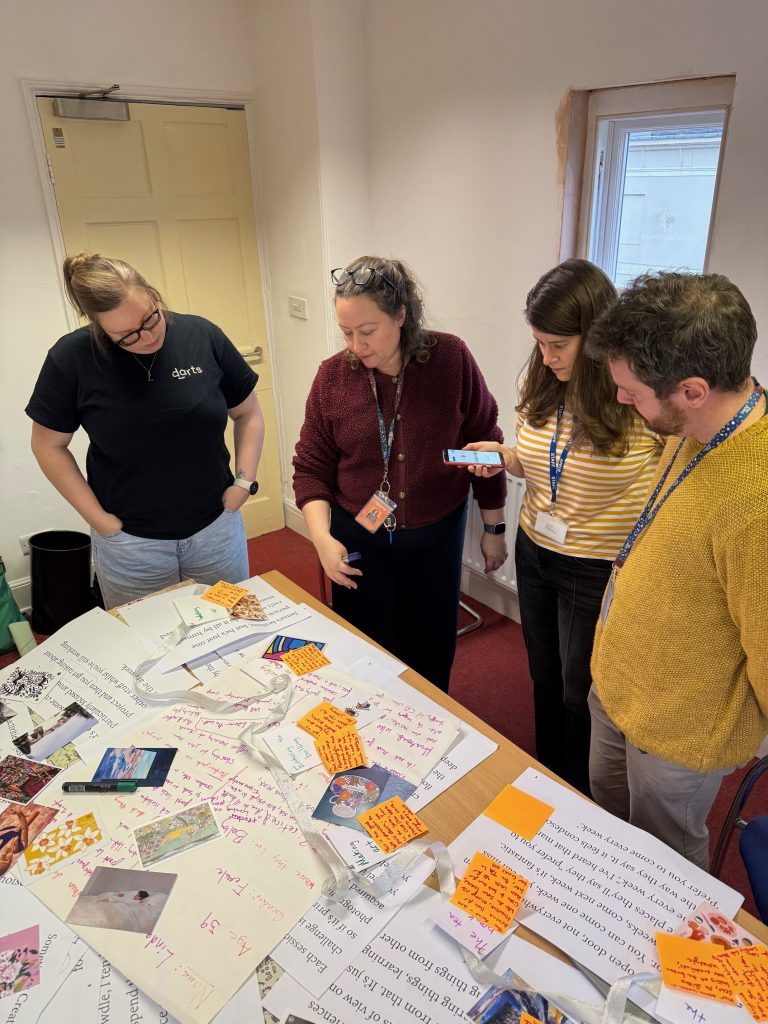
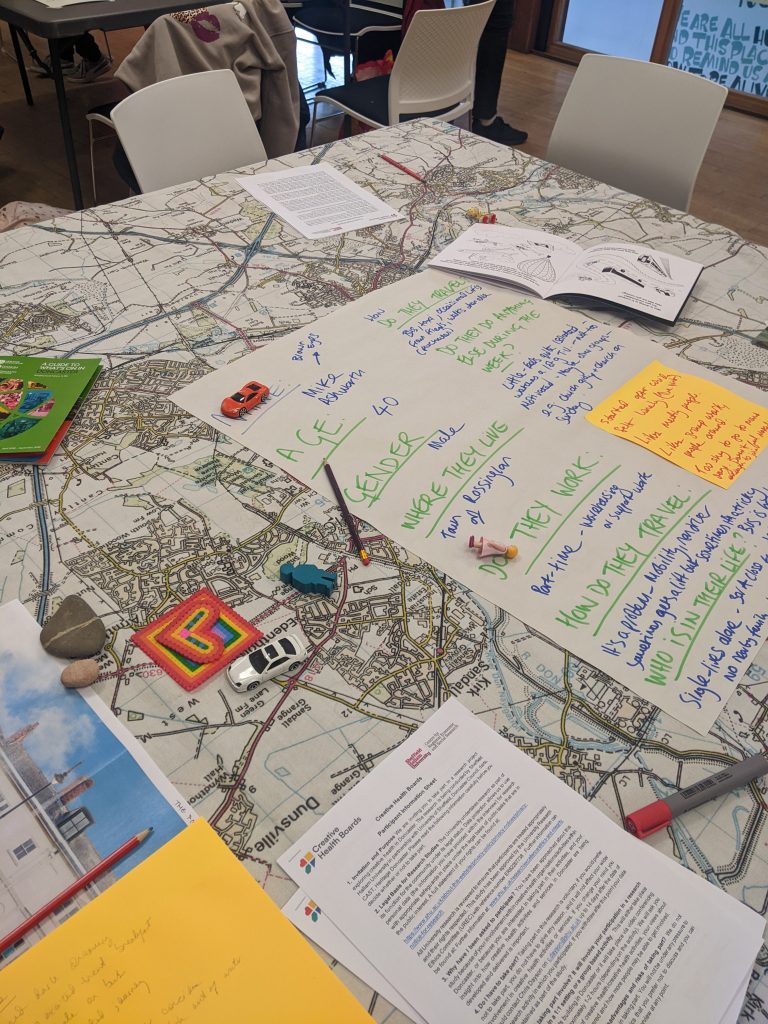
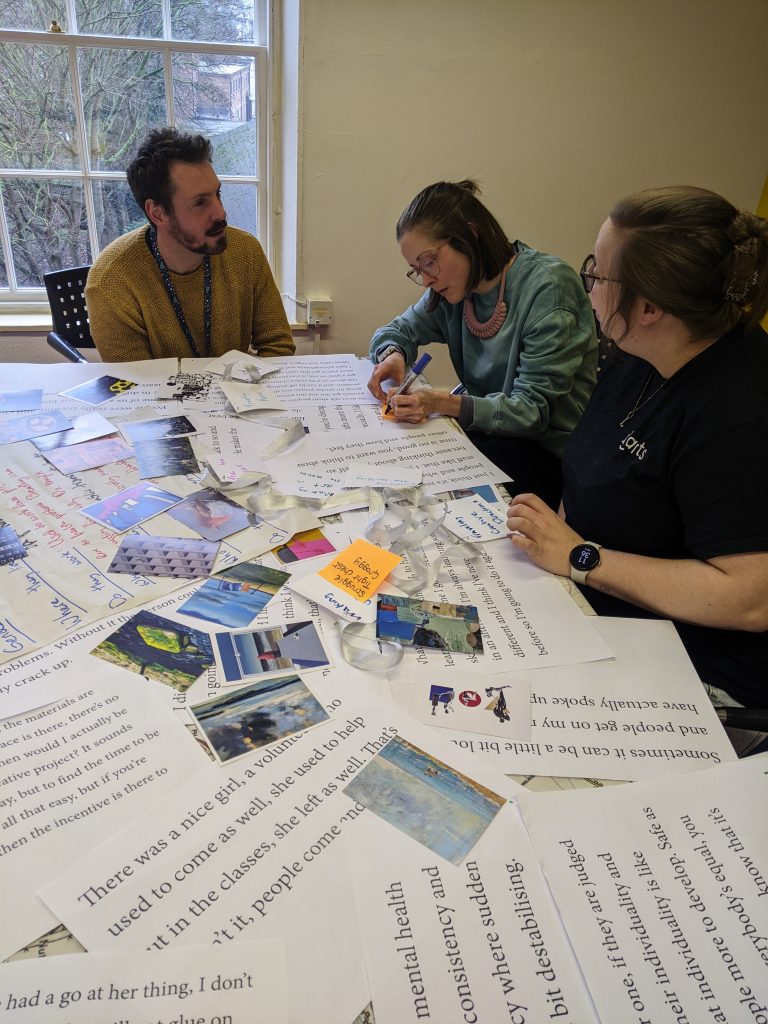
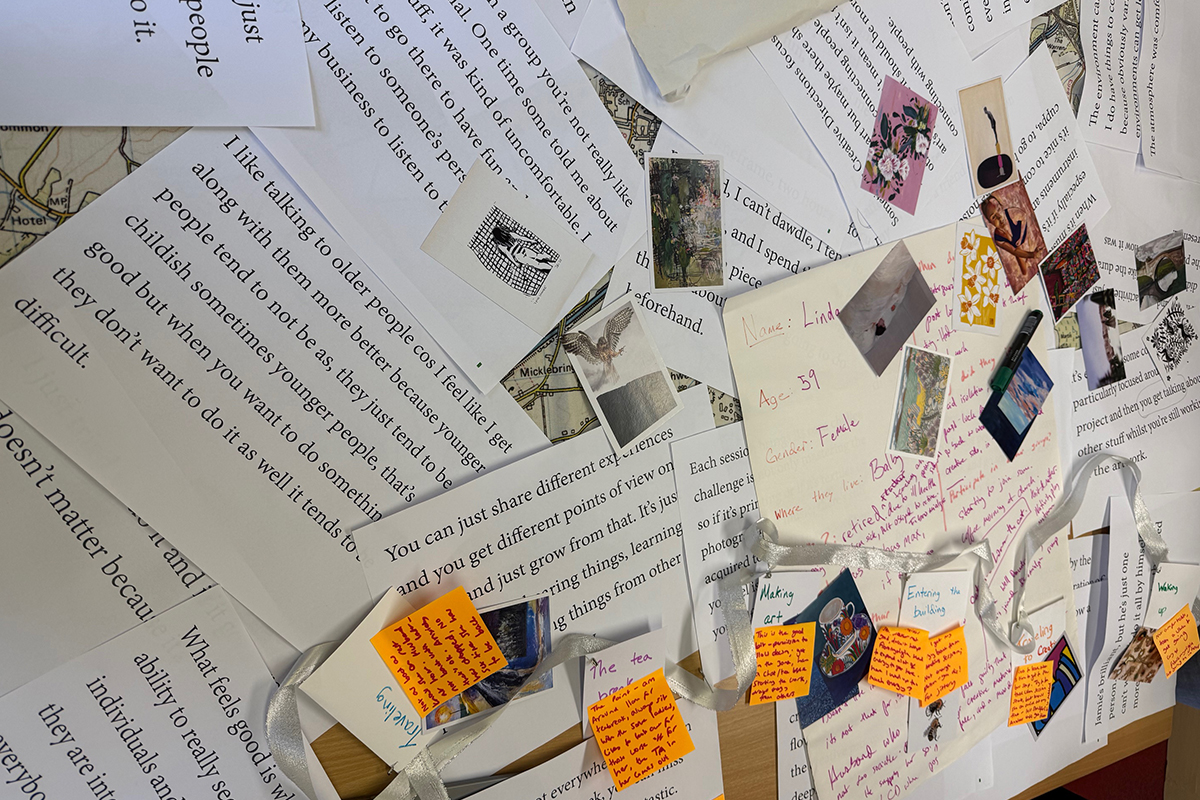
I designed a participatory workshop, inviting in Creative Directions attendees, and present them with snippets from the scenes participants had described in their interviews.
Together we edited these snippets into storylines and composite personas. By presenting the information with a gap – I was inviting them to bridge it using their implicit knowledge – their lived experiences of attending Creative Directions for many years – to fill in the details.
Then I took the personality sketch and storyline participants had created, as well as the images and quotes they had selected to accompany the persona, and refined them into a narrative character sketch of the Persona, their background, and their journey with Creative Directions.
Outcomes
I ran this workshop twice, once with Creative Directions participants, and once with darts staff. Through this process we developed four personas.
The participants remarked that they found this method engaging and creative.
The personas themselves offer detailed and poignant insight into why an individual might attend Creative Directions.
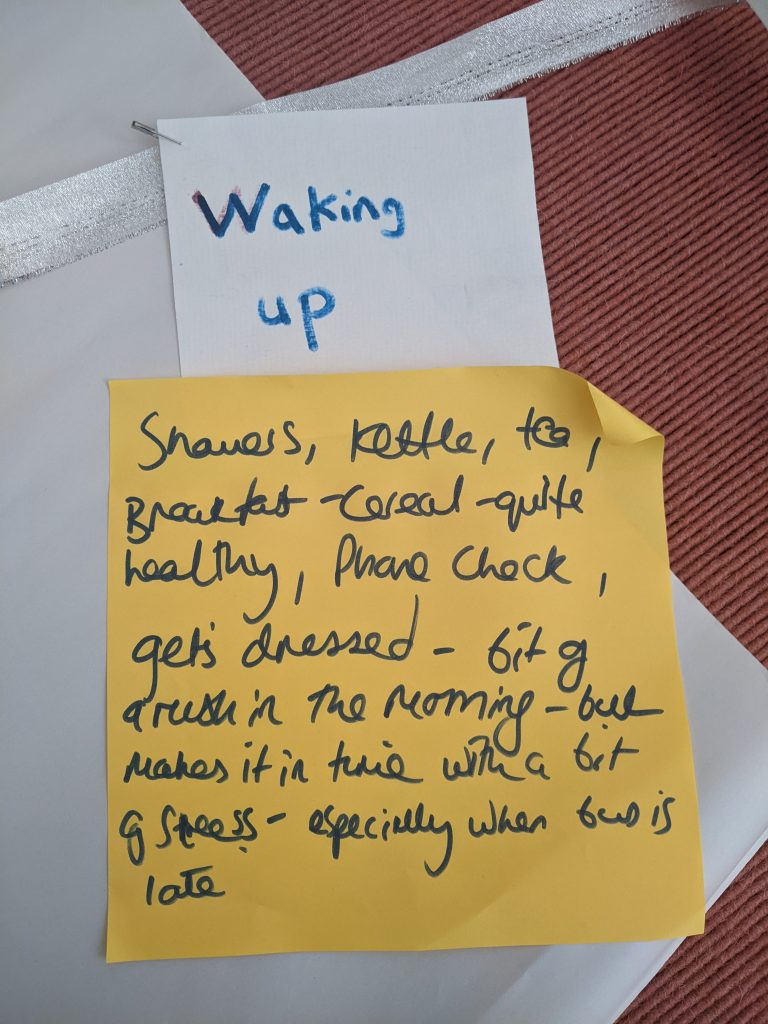
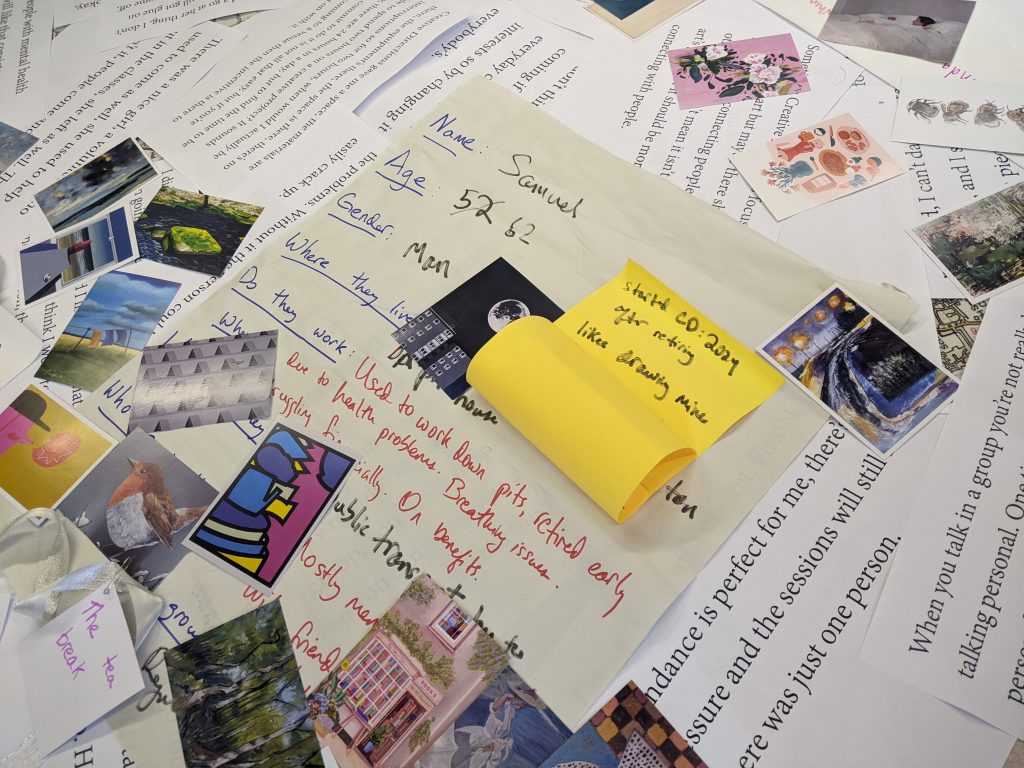
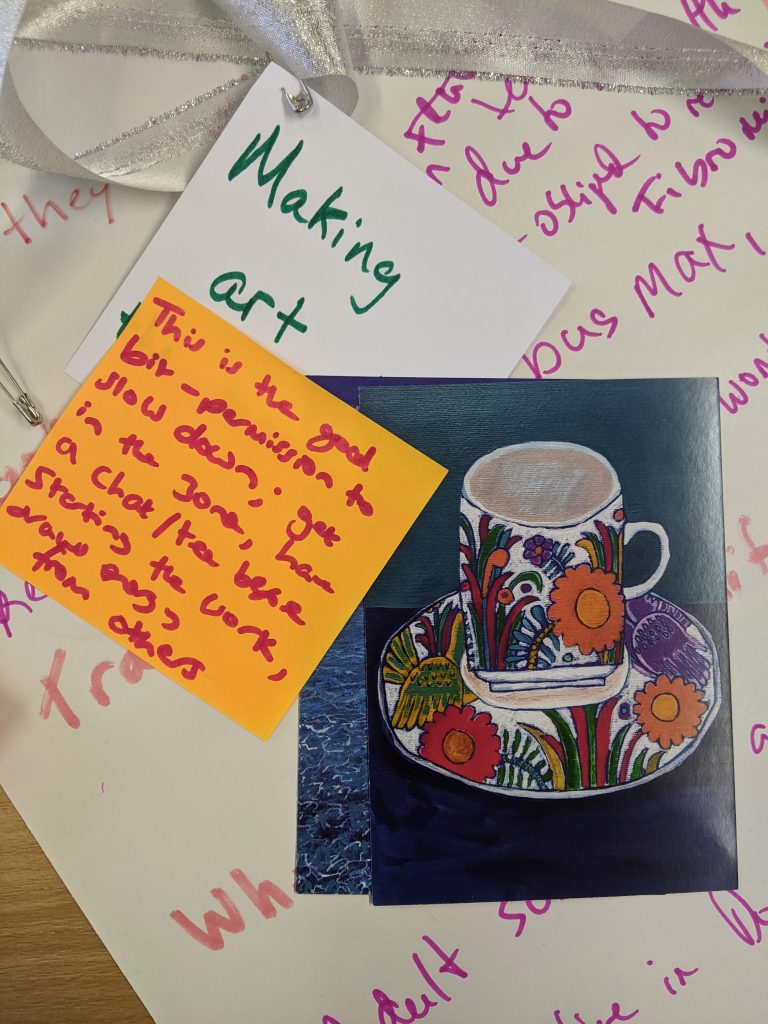
For your reading pleasure – here’s one of the four personas that participants generated through the workshop process.
Mike’s Story
Narrative Persona Sketch: Mike Ashworth
Thursday mornings begin in a haze for Mike Ashworth. Sleep rarely comes easily, often filled with dark dreams. When he wakes, he feels worn out, confused about what day it is. But then the realization dawns – ‘Oh it’s Thursday, Creative Directions, I love it.‘
Getting out of the house is never simple. His mobility issues mean every step requires effort, and travel is a constant barrier. Still, with his aid and determination, he makes his way into Rossington. Breakfast at his favourite caf is a special Thursday treat – a fry‑up with coffee, a indulgence he allows himself once a week. On the rare occasions the caf is closed, he’ll settle for Spoons. The routine matters more than the food.
The bus ride is harder. The step up feels monumental, and the weight of strangers’ eyes presses on him. Past experiences of overheard comments still sting, leaving him self‑conscious. He sees himself as a beached whale struggling to move. Yet once seated, staring out the window, the sight of passing trees and fields calms him. Nature doesn’t judge.
Arriving at The Point, nerves return. No matter how many times he’s attended, Mike still fears rejection. ‘When I get to Creative Directions, it’s challenging trying to get comfortable. Just trying to socialise and everything.’ He bypasses the café and heads straight into the room, tired from the journey, feeling like a fish out of water. It’s helpful to know Jamie, the facilitator is a friendly face who will be in every session. ‘Jamie coming around asking if you’re okay, you do get to offload a bit. I don’t get to do that too often. It’s cos I know Jamie from past, I know it’s something what he understands with me cos we have similar conditions so it’s easier to offload a bit.‘
Once the art task is in front of him, everything shifts. His focus sharpens, and the noise of doubt fades. ‘It feels almost like daydreaming but it’s in a creative way, just letting the imagination flow and to be able to think about art and the creative process without delving too deeply, just go with the flow.‘ Colours, shapes, and ideas take over. He feels part of something larger, a buzzing hive of creativity where his problems dissolve and his imagination takes flight.
He’s proud of his work and what he’s accomplishing. ‘Each session brings its own challenge. The challenge is not only mastering the technique, so if it’s printing or if it’s textiles or photography or music, there’s still a skill to be acquired to be able to produce something that you feel is worthwhile, that is of value to yourself.‘
Tea break unsettles him again. The cohesion of the group scatters, and anxiety rises in his belly. Choosing where to sit, what to say, feels daunting. Yet with a hot drink in hand, the tension eases, and returning to the activity restores his calm.
The journey home is familiar – still tinged with apprehension, but Mike is buoyed by the sense of accomplishment. Dinner is simple, often a ready meal or soup and toast in front of the TV with the cat. Yet Thursday evenings feel different, calmer, less heavy.
Mike’s path to Creative Directions was hesitant. He first heard about it from a stranger at the chemist. He went home, immediately Googled it, and was intrigued by the ‘just turn up’ message on the website. It was the period about a year after COVID ended, when everyone else had taken up normal life again and he was feeling increasingly low and isolated. His family lived too far away to reach by public transport, and he couldn’t drive. His close friends were all married or divorced with kids, and working full time, so he was rarely seeing them either. He had made a few acquaintances through his part time work, but it wasn’t enough to feel meaningful.
He called up the Point and asked about the session, the woman on the phone said: ‘Why don’t you come and check it out this week? You can come early and get a tour of the building if you want.’ It took a few months of deliberating and worrying they’d all be crazy, before he decided he had to give it a go.
Mike found the first session overwhelming and he left early. But something – the friendliness, the free tea, the lack of fuss about his mobility – drew him back. ‘I were a bit nervous at first but ever since then I’ve loved it. I were quite surprised actually, I was quite shocked how settled I felt. I got to know people and it’s been wonderful, really, really good.‘
Over time, he’s had powerful moments of belonging, especially when he helped a newcomer through their own nerves. ‘Some people are having a bad time, I’ve had a chat with them and helped them and that gave me a good satisfaction. It gives me a lot of satisfaction to help somebody, to give a little bit back.‘
Illness and mental health struggles pulled him away for a while. He began to isolate, certain that he was burden and didn’t deserve much. One friend came around to check on him and suggested he rejoin Creative Directions, which he had talked about enjoying so much. He was nervous that people would be upset with him for dropping off the radar but when he walked in the room he heard: ‘Hi Mike!’ as if no time had passed. ‘The longest time I haven’t been was like a month or something and when I went again people were talking to me and asked me how I am doing and it brings a smile to my face cos it feels like they want me to come.‘ The warm welcome reminded him he belonged.
Creative Directions has changed Mike’s life. It has eased his isolation, given him confidence to travel to new places in town, and opened the possibility of volunteering at Creative Directions. He’s proud of his new creative skills, but the sessions are more than just art – they are a bridge back to trust, community, and a sense of being seen. Thursdays are no longer just another day; they are proof that he can step out of loneliness and into connection.
Cite this article:
Maleney, C. (2026, April 30). What is a Persona? https://doi.org/10.7190/chb.2026.5682231159