Sarah Trentham Black and Eleanor Lockley
Our third Creative Health Learning Board Network session focused on a topic that came up repeatedly when members identified priorities for the network: leadership buy-in.
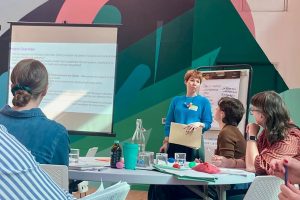
We were joined by Rachael Leslie, Director of Public Health at City of Doncaster Council, and Conni Rosewarne, who works as a Creative Health Lead in Northeast London. Between them, they shared different perspectives on what it takes to get creative health recognised, supported and embedded within wider systems.
Rather than describing a single breakthrough moment, both speakers talked about a process that often unfolds over a long period of time. Conversations, relationships, trust and persistence all seemed to play a role alongside strategies or planned presentations.
Rachael Leslie reflected on her own position coming into creative health. She spoke openly about not seeing herself as a particularly creative person, despite valuing creativity and recognising its importance. In Doncaster, she wasn’t starting from scratch as there was already a rich landscape of organisations, activity and partnerships to build upon. One of the key lessons from her experience was that while mapping assets and activity is useful, maps alone do not create change. The important thing is the connections between people and organisations, and making sure those networks are active and working well.
A significant part of leadership buy-in seemed to involve understanding what matters to other people. Both speakers talked about the importance of linking creative health to existing priorities rather than expecting others to immediately understand its value. That means understanding local health needs, policy objectives, Integrated Care Board priorities, public health agendas and wider strategies, then showing how creative health can contribute to them.
A key theme that was threaded throughout the discussion was stories.
Rachael described using what she called “causal loops”, drawing on examples of creative health in practice to help people understand how activity connects to outcomes. Those stories become even more powerful when people can recognise themselves, their communities or their challenges within them. Data remains important, but there was a strong sense that evidence works best when it is brought to life through examples that people can relate to.
That idea surfaced throughout the session. Whether discussing evidence, advocacy or influencing decision-makers, both speakers talked about the importance of having examples and case studies to hand. Being able to answer the question ‘So what?’ with a real example often seemed just as important as presenting statistics. Hearing from people with lived experience was highlighted as particularly powerful because it demonstrates the impact of creative health on people’s lives in a direct and human way.
For Conni Rosewarne, relationship building sat at the heart of the work. Coming from a community arts background, she described much of her role as slow, relational work. Many opportunities begin with conversations. A discussion with one person can lead to an introduction, which can lead to another conversation, which can eventually create an opportunity to influence decision-making. Much of this happens informally before it ever appears in a formal meeting.
Several participants picked up on the importance of what might be called the ‘water-cooler conversations’- informal moments where ideas are shared, questions are asked and relationships start to develop. Both speakers talked about the value of spending time in other people’s spaces, visiting projects, attending meetings outside your usual area and being present in different environments. Often the groundwork for future change happens there.
The session also prompted an interesting discussion about language and belonging.
Creative health often involves moving between different sectors, each with their own terminology, culture and ways of working. Participants talked about feeling out of place when entering spaces that felt unfamiliar. A creative practitioner working with the NHS may sometimes feel like an outsider, but equally someone from a health background may experience the same uncertainty when stepping into creative environments.
Questions of imposter syndrome came up several times. One response from the speakers was that perhaps this feeling is more common than people realise. Rather than worrying about always knowing the right language, there was encouragement to ask questions, seek clarification and be comfortable admitting when something isn’t understood. Giving people permission to do that was seen as an important part of creating genuinely collaborative spaces.
Another theme running through the discussion was the importance of allies. Finding people who understand the value of creative health and who are willing to champion it within their own organisations can make a significant difference. These supporters can help create opportunities, open doors and keep conversations moving forward when progress feels slow.
The speakers also acknowledged that the wider environment is not getting any simpler. Health systems are under pressure, staffing structures continue to change, funding is uncertain and key contacts often move on. Keeping track of leadership networks and maintaining relationships is therefore an ongoing task rather than something that can be done once and forgotten about.
Conni spoke about the importance of continuing to advocate even when the immediate answer is no. She highlighted the value of understanding funding partnerships, emerging commissioning opportunities and local structures, but also stressed that much of the work depends on patience. Relationships take time. Trust takes time. Change often takes longer than people would like.
There was also discussion about the balance between formal and informal advocacy. Presentations, reports and meetings all have their place, but many important opportunities begin through everyday conversations. Those conversations can create openings that simply would not emerge through formal channels alone.
Perhaps the biggest takeaway from the session was that leadership buy-in rarely happens through a single meeting or a perfectly worded business case. It develops gradually through relationships, trust and repeated conversations, when people can see how creative health connects to the priorities they are already working towards, when evidence is supported by stories, and when stories are backed up by evidence.
As we wrapped up the session, we couldn’t help to reflect that the relational work that takes time is the thing we are offering in the Creative Health Learning Network.
Cite this article:
Trentham Black, S., & Lockley, E. (2026, Oct 2). Leadership Buy-in in Creative Health: relationships, stories and finding common ground. Creative Health Boards. https://doi.org/10.7190/chb.2026.2269543109